





I’ve cut hundreds of feet of cardboard, oak dowels, and paracord in addition to dozens of apples, wire ties, and water bottles while testing EDC knives. I used my experience performing those cut tests and getting plenty of pocket time with over 50 knives to put together my picks for the best EDC knives.
My top picks include options under $50, some over $600, multi-tools, and pocket fixed blades. So no matter what your ideal daily carry knife is, there’s an option in this review for you.
Folders
Fixed Blades
Multi-Tools
Traditional Pocket Knives
High-End Folders
Folders
Best USA Made: Kershaw Bel Air
See It
Pros
- Good action
- Great blade shape and grind for EDC tasks
- Thin and easy to carry
- Excellent ergonomics
Cons
- Aluminum scales lack traction
Key Features
-
KVT ball bearings -
Lock Type:
DuraLock -
Pocket Clip:
Reversible deep-carry (right/left, tip-up) -
Warranty:
Limited lifetime warranty -
Blade Length3.1 inches -
Blade Material:
CPM MagnaCut -
HRC:
62 to 64 -
Blade Finish/Coating:
BlackWash -
Blade Thickness:
0.09 inches -
Closed Length4.2 inches -
Handle Material:
6061-T6 aluminum -
Handle Finish/Coating:
Cerakote -
Handle Thickness:
0.44 inches -
Overall Length:
7.3 inches -
Weight:
2.9 ounces -
Price:
$150
My first impressions of the Bel Air set a high bar. When I took the Bel Air out of its box, I flicked it open and experienced one of the best crossbar lock actions I’ve handled. The quality build is immediately evident and with a Mangnacut blade, it’s offered at a great price ($160).
Kershaw Bel Air Action and Cutting
A look at the Bel Air’s action and cutting ability.
The Bel Air truly impressed me when I tested it head to head against the WE Banter — one of my favorite EDC blades. The Banter has a slightly better action, but the Bel Air cuts circles around the Banter. Its blade flew through cardboard, dug deep into wood, and breezed through various cordage.
Of all the EDC knives I’ve tested this year, the Bel Air is the most refreshing. A lot of companies are taking serious flack for pricing knives way too high. Yet, here is a knife that’s priced very fairly for its materials, performance, and country of origin. I’m safely calling this the best value in American made knives and a great buy for anyone looking for a quality pocket knife. The only criticism I have for this knife is a lack of traction on the aluminum scales.
Read Next: Best Knives Made in the USA
Best New Design: Civivi Yonder
See It
Pros
- Good all-around cutter
- Very comfortable ergonomics
- Easy to carry
- Compact, but still plenty of grip real estate and blade
Cons
- Not the best for cutting cordage
Key Features
-
Price:
$67 (Retails for around $60) -
Very lefty friendly -
Weight:
2.8 ounces (measured) -
Closed Length:
3.74 inches (measured) -
Open Length:
6.63 inches (measured) -
Thickness:
0.45 inch (measured) -
Blade Stock Thickness:
0.09 inch (measured) -
Thickness Behind the Edge:
0.01 inch (measured) -
Sharpened Edge Length:
2.73 inches (measured) -
Spade-point blade -
Blade Material:
14C28N -
Blade Hardness:
58-60HRC -
Crossbar lock -
G10, micarta, or wood scales -
Caged ceramic ball bearings -
Designer:
Zac Whitmore
After testing and carrying the Civivi Yonder over the last year it became one of my favorite pocket knives of all time. Especially when you consider its $60 price tag.
The Yonder is a good general purpose slicer thanks to its thin grind and sweeping belly. The Yonder’s spine measures 0.09-inch thick and just behind the edge, the Yonder measures 0.01-inch thick. I tested on thick cardboard and its blade geometry carved it up with ease. I also cut paracord, which would slip down the blade before being cut due to the knife’s belly.
In the pocket, the Yonder is among the best I’ve carried. It’s out of the way, discreet, and easy to deploy when needed. Read my full Civivi Yonder review to learn more.
Best Under $50: CJRB Pyrite and Pyrite Light
See It
Pros
- Excellent action
- Easy to close
- Thin and light
Cons
- Can be uncomfortable to use for extended cutting sessions
Key Features
-
Price:
$28 -
Blade Length:
3.34 inches -
Blade Materieal:
AR-RPM9 -
Button lock
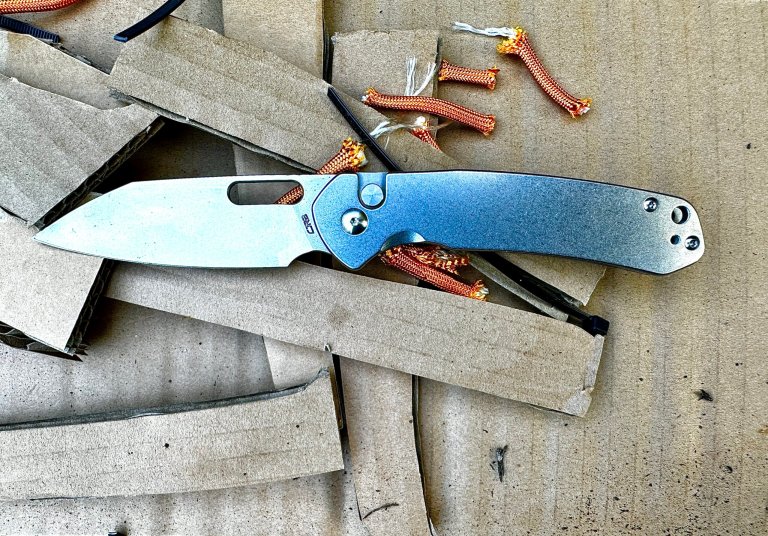
This is a thin, slicey knife that’s easy to carry and easy on your wallet. It has a snappy action and closing it is has easy as pressing a button. In my cut testing it performed well, but its thin grip created hot spots toward the end of the cutting session.
Best Hard Use: Zero Tolerance 0308
See It
Key Features
-
CPM 20CV blade steel(HRC60–62) -
KVT ball-bearing -
Titanium framelock with hardened steel lockbar insert -
Pocketclip:
Reversible -
Blade Length:
3.75 inches -
Blade Thickness:
0.156 inch -
Closed Length:
5.2 inches -
Handle Material:
G10 front, titanium back -
Price:
$251
Zero Tolerance 0308 Action
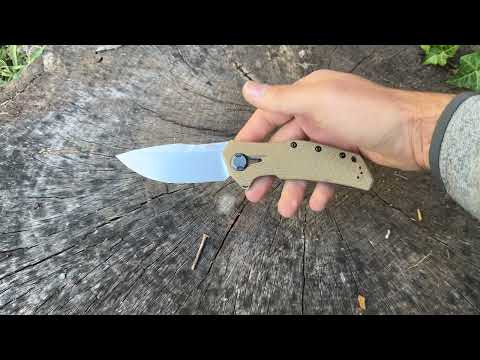
A look at the ZT 0308’s action. Turn the sound on to hear the blade lock into place and the detent snap the blade back in.
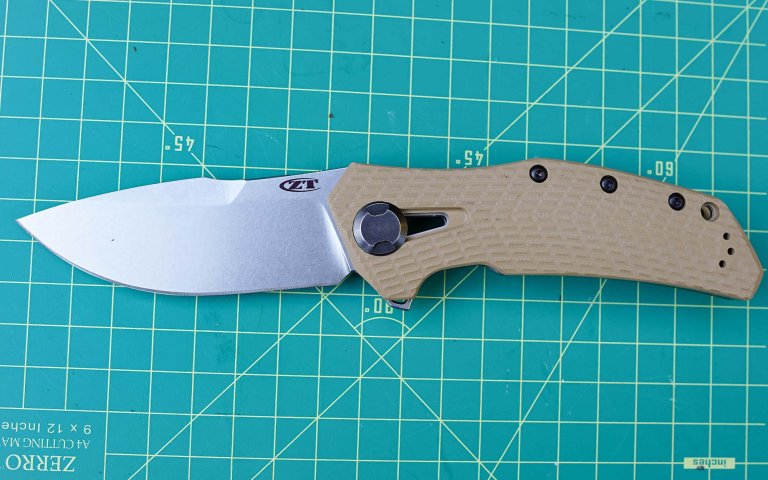
Zero Tolerance was one of the first brands that I went nuts over. The ZT 0308 captures the spirit of the over-built knives that first grabbed my attention. It’s a big knife, but the action is dialed perfectly and it fires out the 3.75-inch blade with authority. It’s so much fun to hit the flipper tab and feel the giant blade lock into place. It has a comfortable thumb ramp with grippy jimping that doesn’t bite you back. With your thumb placed there you can put a lot of power into your cuts and do so without developing a hot spot. I might still be in the honeymoon phase with my 0308, but it’s one of the more exciting folders that I’ve got this year and I’m loving carrying it.
See It
Pros
- Innovative lock
- Durable
- Good ergonomics
- Three deployment methods
Key Features
-
Blade Length:
3.18 inches -
Blade Material:
Elmax or 154CM -
Aluminum Handle -
HRC:
58 to 62 -
Weight:
4.76 ounces -
Reversible Pocket Clip -
Vanchor lock -
Blade Thickness:
0.134 inch -
Price:
$130 to 170
The Vosteed Ankylo has a super lock, a great steel, and costs well under $200. That’s a fantastic value for a hard-use folder. It’s action isn’t the best I’ve tested, but it still flips well using either the flipper tab, front flipper, or blade hole. You can also bush down the lock release button and flip the blade out with a little wrist snap.

Vosteed Ankylo
A look at the Ankylo’s action.
The Ankylo cuts surprisingly well for a thick blade. I found the cutting performance acceptable for most EDC tasks. The real magic of this knife is in its lock. There’s a metal insert in the scale that clicks securely into a cut out in the blade. A button on the pivot that compresses the lock and then the blade can be folded. It’s a well-executed design and it solves a lot of issues most button locks have. Mainly that a button lock can be accidentally unlocked while the knife is in use. But the Vanchor Lock put the button in a location that is very difficult to accidentally press .
The main downside of the Ankylo is that it is a thick, heavy knife. It can be a burden to carry. Yet, for times when you need a knife that can handle tough tasks, it’s a great one to have in your pocket. — Scott Einsmann, gear editor
Best OTF: Guardian Tactical Scout
See It
Key Features
-
Overall Length:
8 inches -
Blade Length:
3.45 inches -
Blade Material:
Elmax -
Hollow grind -
Closed Length:
4.5 inches -
Price:
$395
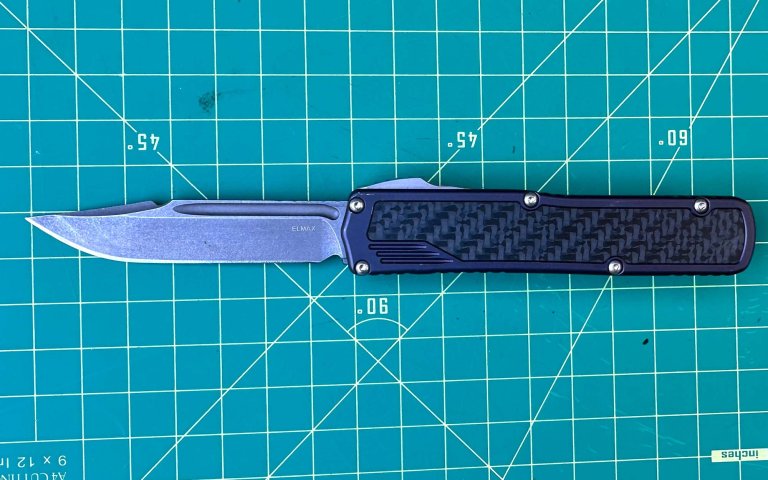
I always thought OTFs were cool, but when my Halo V became a glorified letter opener, it was proof that I didn’t quite see their utility. That was until I got my Guardian Tactical last year. This slim double action OTF is easy to carry and it opened my eyes to how practical this knife design is. You can pull the knife from your pocket, shoot the blade out, make a cut, and have it back in your pocket in seconds. It’s so much faster and efficient than a typical folding knife or even a side opening auto.

Guardian Tactical Scout
A look at the Scout’s action.
The knife itself is well made with minimal blade play, a snappy action, and you can fidget with it without getting tired. I especially like the design of the switch which gives you proper leverage while being ergonomic. The carbon fiber inlay adds class and it doesn’t have the aggressive look of more tactical OTFs.
It’s worth mentioning that there are a lot of excellent OTFs made in America. The Microtech Ultratech, Benchmade Shootout, and Kershaw Livewire are all great knives and which you choose is ultimately a matter of personal preference.
See It
Pros
- Highly corrosion resistant
- Durable blade shape and edge grind
- Comes very sharp from the factory
Cons
- I’d prefer a thinner, slicier blade for this role
Key Features
-
Blade Length:
3.8 inches -
Overall Length:
9 inches -
Weight:
4.2 ounces -
Available in full size and mini -
Deployment Methods:
Thumbstud -
Blade Material:
Magnacut -
Grivory handle -
Price:
$250
If you take a standard pocket knife, even in a stainless steel, and submerge it in saltwater you’ll get some rust spots. Not to mention the damage saltwater will do the screws, bearings, and other small parts. But, the Adira is built to treat that type of abuse as just another day on the job. I wore the Adira swimming in saltwater, and didn’t rinse it after. A week later it was still pristine. I’ve been using it as my go-to kayak fishing knife where it cuts bait and bleeds out fish. Its sharp edge and Maganacut’s inherent toughness means I can go right through bones and gill plates without worrying about edge damage.
The full size option is a big knife, and I think most people will prefer the mini for EDC and typical cutting tasks. If you’re a diver, crabber, or you’ll use the Adira as a bait knife, the full size option is the way to go. Its long blade is ideal for cutting rope and you’ll have plenty of purchase even when wearing gloves.
It’s worth noting that Magnacut is highly stain resistant, but it’s not the most rust proof steel option available. I’d recommend rinsing and drying the knife after a dip in the salt, even though mine has thrived on neglect. Do as I say, not as I do.
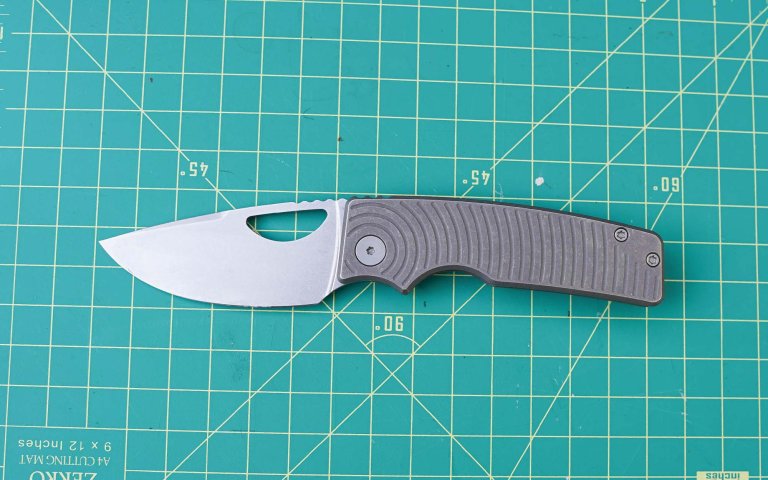
My Favorite: OZ Machine Company Roosevelt
See It
Key Features
-
Blade Length:
2.9 inches -
Over Length:
7 inches -
Weight:
2.9 ounces -
Blade Thickness:
0.375 inch thick -
Hardware and scales made from grade 5 titanium (including screws) -
10 ball ceramic bearings in Delrin cages -
AEB-L lock insert with two ceramic detent balls -
CPM MagnaCut Blade (63 to 64 HRC) -
All components made by Oz Machine Co. -
Price:
Starting at $700
At a certain point a knife is just a knife. If you keep it sharp it’ll perform normal cutting tasks well. But some knives are more than just a cutting tool. They are a source of daily happiness and an extension of the person carrying them.

Oz Machine Co Roosevelt
A look at the Roosevelt’s action.
The latter is the world where the OZ Machine Company Roosevelt (Rosie) exists. The basic function of cutting is of course important, but people who are excited to spend $800 on a knife want more than a razor blade. They want impeccable machine work, exciting design, and an action that’s supremely satisfying. The Rosie delivers all of this at a very high level. It’s also thoughtfully designed for carry and daily use. It’s shockingly light and thin, yet perfectly comfortable while cutting. One of the reasons why the Roosevelt is such a high quality folder is that every component is made in house, including the screws and bearings. Add in tight tolerances and strict quality control and you end up with a knife that is, in a word, perfect.
The main negative of the OZ Rosie is its availability. It took me nearly a year of trying to get one and they aren’t getting easier to find. OZ simply can’t make enough to satisfy the demand, which causes crazy secondary market prices. The hunt for one of these coveted knives is frustrating, but it’s also part of the fun and it’s a signal that there is serious demand for knives at the pinnacle of quality. If you want one of these knives I recommend signing up for email alerts, following Oz Machine Co on social media, going to knife shows that Oz Machine Co attends, and keeping an eye on R/Knife_Swap.
Fixed Blades
Best Overall: Schwarz Overland Sport
See It
Pros
- Purpose built for pocket carry
- Excellent sheath
- Incredible ergonomics
- Cut all mediums well
Cons
- You can’t just buy one. You’ll have to wait for a drop or place an order and wait one to two months
Key Features
-
Blade Steel:
MagnaCut -
Handle Materials:
G10 or Micarta in various colors -
Overall Length:
6.6 inches -
Blade Length:
2.8 inches -
Blade Thickness:
0.130 inch -
Grind:
Flat -
Comes with a Kydex sheath set up for pocket carry with an Ulti-Clip -
Made in USA -
Price:
$265
The best overall pick for the fixed blade category came down to the Overland Sport and the Lookout. The difference maker was the Overland Sport’s better ergonomics and cutting ability. Its ergonomics are natural and secure. Your thumb lands on the jimping, which isn’t too sharp or too dull. Your index finger sits close to the sharpened edge for control, but it’s not in danger of slipping forward during heavy use. The G10 scales I ordered for mine could use a little more texture, but they’re thoughtfully milled with leverage and index points. Let’s say you need to use a pinch grip or index finger on the knife’s spine. There’s a divot on the grip for your thumb, which gives it a ledge to push off against. With a thumb on top of the knife, your middle finger lands in the ferrule milled into the grip. Again, it gives a comfortable and secure leverage point.
While the Overland Sport is a better knife than the Lookout, it lagged behind in the sheath department. The Schwarz uses a pancake-style sheath and an ULTICLIP to secure it to your pocket. That style of sheath takes up more space in the pocket and the ULTICLIP isn’t my favorite attachment method.
The Overland Sport is a small-batch knife, which is excellent for quality control but not ideal if you want a knife right away. You’ll currently wait two to four weeks before you receive your custom order, or you can try to snag one on the weekly drops. In my opinion, if you want a knife that’s a well-rounded cutter and is easy to carry, there’s no better option than the Overland Sport.
Read Next: Best EDC Knives
Best for Pocket Carry: Big Idea Designs Lookout
See It
Pros
- Purpose built for pocket carry
- Perfect sheath
Cons
- Grip needs more traction
Key Features
-
Blade Steel:
M390 (China) or MagnaCut (USA) -
Handle Materials:
Grade 5 Titanium, G10, Tigerwood, Ultem, and Natural Micarta -
Overall Length:
6.2 inches -
Blade Length:
2.2 inches -
Blade Thickness:
0.12 inch -
Grind:
Flat -
Comes with two Kydex Sheaths (left and right pocket carry) w/ titanium pocket clip -
Made in China and USA -
Price:
$200 (China) or $250 (USA)
This knife isn’t the best for hard use. It’s not even the best slicer. Its ergos are good, but they’re not great. So why is it my favorite EDC fixed blade for pocket carry? Its design and execution are perfect. When you carry and use it you can tell that someone put a lot of thought into how this knife and sheath needed to work around being carried in a pocket.
The result is a completely intuitive user experience where pulling the knife out and dropping it back into the sheath takes no thought. Other knife companies should take note of the sheath design because it’s the only one I’ve tested that works flawlessly for pocket carry — although the Overland Sport is very close. The sheath has ideal pocket clip tension and a small footprint. Most taco-style sheaths attach the clip to the rivet holes near the edge side. But, the Lookout’s clip is moved closer to the center of the sheath, which prevents the clip from blocking access to the knife and moves it tight to one side of your pocket.
The knife was in the second tier of cutters, but it’s plenty slicey for most EDC tasks. The jimping is too smooth to provide enough traction, and the titanium scales on my model are slick. If you want to use the Lookout for hard-use tasks, I’d recommend getting the USA-made model with G10 or Micarta handles.
Best Budget: Boker M.U.K.
See It
Pros
- Good sheath
- Good cutting performance
Cons
- Some sharp corners on grip
Key Features
-
$50 -
2.4-inch blade -
14C28N steel -
2.1 ounces
The M.U.K. is an undeniably cool knife, and I was pleasantly surprised it was a performer too. The blade has a ton of belly, which is great for slicing cuts. The ergonomics are good, but the handle could be longer and the back end of the handle comes to a sharp point. The sheath is well made and it comes with a pocket clip, so you can drop the knife in your front pocket.
Best Big Knife: TRC Classic Freedom
See It
Pros
- Light for its size
- Slicey
- Great ergonomics
- Good sheath for belt carry
- Incredible finish
Cons
- Not always available in stock
Key Features
-
Blade Steel:
M390 -
Handle Materials:
Micarta -
Overall Length:
8.08 inches -
Blade Length:
3.63 inches -
Blade Thickness:
.107 inch -
Grind:
Flat -
Price:
$280 -
Made in Lithuania
If the Overland Sport and Lookout blades are too small for your needs, the next best option is the TRC Classic Freedom. It’s about 1.5 inches longer than both of those pocket-carry options and what you get in return is more handle and more blade. I wear an extra large glove, and I can get a full grip with room to spare. The grip has a ledge near the ricasso where your thumb can get leverage while using a finger-on-spine grip. The handle area is skeletonized to reduce weight and it puts the balance point where your ring finger sits. The spine is rounded and very comfortable when putting hard pressure on it.
The blade came insanely sharp, and it was easily in the top tier of cutters in the test. Its classic drop point shape is perfect for nearly all cutting tasks. It can do food prep, feather sticks, field dressing, and EDC tasks. So it’s an ideal blade for camping, hunting, and doing chores around the house.
The sheath has perfect retention and comes configured for horizontal belt carry. You could remove the belt strap and add a pocket clip if you’d like.
Another reason the Classic Freedom is one of my favorite EDC fixed blades is its incredible build quality. The spine and all hand-contact points are polished and rounded. There isn’t a single flaw on mine and its knife that can be appreciated by serious users and collectors alike.
Read Next: Best Knife Sharpeners
Best Hunting/EDC: ESEE Sencillo
See It
Pros
- Excellent ergonomics in all grips
Cons
- Great knife, so-so sheath
Key Features
-
Blade Steel:
MagnaCut or A2 -
Handle Materials:
Brown Burlap Micarta -
Overall Length:
7.25 inches -
Blade Length:
3 inches -
Blade Thickness:
0.12 inch -
Grind:
Flat -
Kydex sheath with belt loop -
Made in USA
There’s a lot to love about the ESEE Sencillo. It’s a great value at under $200 for a USA-made knife with excellent materials and good build quality. Its tall, fully-flat-ground blade is a slicing machine that was a tier-one cutter in my test. The ergonomics are very secure, and the handle fills your hand, so you can get a lot of control over your cuts. This was by far one of the best food prep knives and would also make a great hunting knife.
This is an all-to-common case of a great knife with a basic sheath. The sheath will work well for belt carry, but I’d recommend getting an Armatus sheath if you want to carry it horizontally on your belt or Roac sheath for pocket carry.
Best Outdoor EDC: White River Knives Exodus 3
See It
Pros
- Easy to carry
- Versatility
Cons
- Not the best dedicated hunting knife due to a lack of slicing ability
Key Features
-
Micarta handle -
2.3 ounces -
7.2 inches overall -
3.15-inch blade -
S35VN steel (58-60 HRC) -
Kydex sheath -
$140 -
Made in USA
The Exodus 3 was designed to be the knife that you always have on you and can handle a wide variety of outdoor tasks — from fire making to processing game. It has a fairly thick blade for its size and blade height, which doesn’t make for the sliciest cutting geometry. The handle is comfortable in any grip and is smartly designed for its size. It comes with a quality sheath that’s set up for horizontal belt carry. I’d score this as a good knife for hunting and a great knife in terms of utility, purely due to its lack of slicing ability.
I find myself carrying this knife all the time. It’s irresistibly fun to use and carry. It’s small size, versatile ergonomics, and overall utility make it one of my favorite knives. I’d like to try out its larger sibling the Exodus 4 (aka Jackalope) because its taller blade height should make it a touch better at slicing.
Best Overall: Leatherman Arc
See It
Key Features
-
Main Tools:
MagnaCut knife, pliers, bit driver, diamond-coated file, small bit driver, wood/metal file, pry tool, screwdriver, bottle opener, can opener, awl, scissors, and saw -
Weight:
8.6 ounces -
Closed Length:
4.25 inches -
Primary Blade Length:
2.76 inches -
Blade Hardness:
60-63 HRC -
Width:
1.3 inches -
Overall Thickness:
0.68 inch -
Materials:
420 Stainless Steel, 440C Stainless Steel, DLC Coating, MagnaCut Steel, PVD Coating -
Included Bits:
Torx #10 & #15, Torx #20 & #25, Screwdriver 3/32″ & 1/8″, Pozi #2 & #1, Hex 1.5mm & 2mm, Hex 2.5mm & 3mm, Hex 4mm & 5mm, Robertson #1 & 2, Robertson #2 & 3 -
Tools lock into place -
Price:
$230
I’m a fan of the show Alone and think there’s a lot to learn from watching people’s experiences on the show. One interesting take away is that seven of the 11 Alone winners have chosen to take a Leatherman multi-tool over a fixed blade knife as one of their 10 items. The Leatherman Free, Surge, and Wave have all been used on the show. The new Arc takes many of the best qualities of those multi tools and adds in a MagnaCut blade. I’ll hopefully never have to use it to survive 90 days in the wilderness, but I do use my Arc to solve problems daily. The Arc can be opened with one hand and all 10 tools deploy easily. I like that they’re all highly useful tools and there’s no fluff, so you’re not carrying around something you’ll never use.
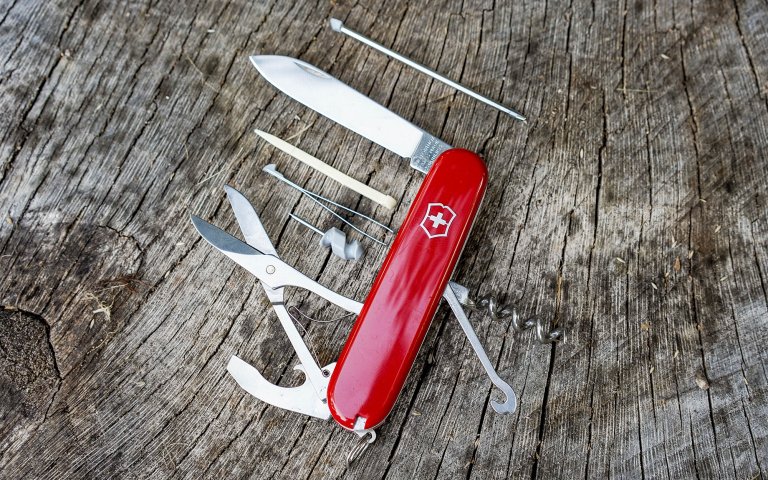
Easiest to Carry: Swiss Army Compact
See It
Pros
- Light and easy to carry
- A lot of useful functions for EDC
Cons
- Blade flexed during cutting
Key Features
-
Blade Length:
2.75 inches -
Overall Length:
6.3 inches -
Weight:
2.3 ounces -
Deployment Methods:
Nail nick -
15 functions -
Price:
$65

Swiss Army Compact
I fully expected the cut test to be too much for the Swiss Army Knife Compact’s thin blade. But it breezed through the test without damage and had good performance. Yes, I could feel the blade flex while pushing into the dowel, but it cut through it with relative ease. The blade is easy to open using the nail nick and smoothly swings out until it snaps into position. There’s a good amount of spring tension to keep the blade open. Although, it’s still not a locking blade so watch out for spine pressure, especially when coming out of a cut.
The Compact is more than just a knife, which makes it especially useful for EDC. While carrying the Compact, the pen was surprisingly handy. You’re not going to use it to write an essay, but it’s handy for those situations when you need a pen in a pinch. I used it at the post office, to sign checks, and jot down quick notes. The scissor is another favorite. It easily cuts through 550 cord, zip ties, and duct tape.
It has enough control to cut out intricate shapes in paper or just a straight line. My only complaint with the scissor is that it’s harder to pull out than the other tools because it sits low. I got some use out of the large flat head, bottle opener, as well as the mini tool, and they’re nice to have. I didn’t use the hook, corkscrew, toothpick, and tweezers, but given enough time I’m sure they’d eventually come in handy.
Best Action: Civivi Sendy
See It
Pros
- Great knife, with a good steel
- Excellent action
- Hidden tools are out of the way until you need them
Cons
- Can only flip the blade open
Key Features
-
Tools:
Knife, tweezers, and metal toothpick -
Price:
$63 -
Nitro V blade -
Flipper -
Liner lock -
Lefty friendly
The Civivi Sendy has a thin, slicey blade that’s perfect for everything from slicing up a summer sausage for lunch to breaking down cardboard boxes. It has an excellent flipper action and the blade flies open. The only downside to deployment is that you have to use the flipper tab, there’s no option to slowly roll the knife open. The tweezers and toothpick are hidden in the knife’s handle. I’ve used the tweezers to remove splinters and pick up screws that fell into a tight spot. Aside from the obvious uses for the tooth pick, it’s also a good eating utensil and it’s handy for tying nail knots.
Read Next: Best EDC Fixed Blades
Best High-End Folders
Oz Machine Co. Roosevelt
The Roosevelt isn’t a knife that’s meant to sit in a drawer or be handled with white gloves. It has a utilitarian finish and it’s been designed specifically to be carried. Keep that in mind if you’re looking to pick one of these up.
I put my Roosevelt through the cut test and it did great, but it didn’t blow the other knives out of the water. It’s a knife with a full-flat grind and a good blade shape—it’ll cut stuff. Where it shines is its incredible ergonomics, engineering, and build quality. The grip was the most comfortable and secure I tested. The amount of blade and handle the Roosevelt has for its folded size is an engineering marvel. It’s also incredibly light for its size. Of course, the build quality is top notch and it has an elite-level action.
If price and availability weren’t a factor, the Roosevelt would be my pick for the best EDC knife. I don’t think there’s a better designed and built knife for daily carry available. But, you just can’t get them without paying a ton or getting lucky on a drop.
Brown Knives Mini FSD-I
If you want an expensive folding knife with instantly recognizable quality, the FSD-I is your knife. It looks and feels high end without being gaudy. The action is the best I’ve experienced and it goes beyond being just smooth—it’s a controlled, hydraulic like smoothness. The detent is just strong enough for the blade to fire out with a reverse flick or the front flipper, but it’s not so strong that you can’t smoothly roll out the knife with your thumb. The machine work is impeccable and there are a lot of neat machining Easter eggs to find. As pretty as the knife is, it’s still a tool and it cuts very well thanks to its hollow grind.
Hinderer XM-18
I get that Rick Hinderer can be polarizing, but there’s no denying his company makes a superb overbuilt folder. The XM-18 is my favorite knife in this class and I think it lives up to the hype. For EDC the 3-inch, non-flipper variant is my top choice. I carry the 3.5-inch non flipper, which is also a great choice if you don’t mind its size.
Koenig Arius
The Arius is like the FSD in that it looks and feels like a quality knife. The flipper action is insanely good, but it’s kind of a one trick pony. My knife’s detent is a little too strong for a reliable reverse flick and it doesn’t roll out for the same reason. The pocket clip on mine is also too tight and I can’t fully clip it onto jeans. Yet, it’s still one of my favorite knives because of the deep hollow grind, great looks, comfortable ergonomics, and fun flipper action.
Traditional Pocket Knives
I tested the Buck 110, Kershaw Federalist, and Case Sodbuster Jr. They all cut very well, but they came up short in different aspects. The 110 and Sodbuster lost their centering after the test and I couldn’t fix them. The Federalist doesn’t have enough tension holding it open for me to feel comfortable using it for anything but light duty. It closed to the half stop even during the cardboard cuts.
Here are some traditional knives I really like:
Jack Wolf
The Jack Wolf knives are the best modern slip joints being made right now. The caveat and why they didn’t win that award, is that they are all limited drops. So if there’s a pattern you like, you might not be able to get it or you’ll have to wait for another run. Those limited drops do make them highly collectible and I’ve fallen down that rabbit hole. For $300 you get an S90V blade, a modern take on a traditional pattern, and superb walk and talk.
QSP Hedgehog
This won my pick for the best modern slipjoint because it’s very close in quality to a Jack Wolf at a fraction of the price. I’d also recommend checking out C. Risner Cutlery’s line of modern slip joints, which are made by QSP and of the same great quality.
Case Sodbuster Jr.
Yes, the Sodbuster was disappointing in the cut test, but I still think it’s a great buy. They’re around $60, made in the USA, and they’re bone jigging is well done. The areas these knives seem to struggle is quality control. In my experience, Case knives have a higher rate of uneven grinds and bad centering. If you want to try a traditional knife, I’d recommend looking for a carbon steel Sodbuster Jr. from a dealer with a good return policy.
GEC and Northwoods
GEC makes the best USA-made production slipjoints, but they’re also among the hardest to get. Northwoods is an even harder-to-get brand made by GEC. If you’re really interested in picking one up here’s what you need to know:
- Check greateasterncutlery.net for what’s currently in production
- It usually takes two weeks to a month for knives to go from in production to available
- Sign up for email alerts from KnivesShipFree (they’re usually the first to get GEC and Northwoods)
- When a drop happens, buy your knife quickly because they’ll sell out in minutes
How I Tested the Best EDC Knives
I’ve collected knives for 10 years and I’ve been able to own some great production knives including my two favorites—the OZ Machine Co. Roosevelt and Brown Knives Mini FDS-I. I also use all the knives in my collection, so while I have deep appreciation for quality machining and a finely-tuned detent, my first priority is always cutting.
My idea of the ultimate EDC knife is one that can tackle any cutting task short of batoning firewood. I need a knife that can make powerful cuts as easily as it makes detailed ones. So I designed my test to find knives that could cut a wide variety of materials and excel at different types of cuts. Once the dust settled on the top performers I took into consideration things like build quality, ease of carry, fidget factor, and value.
The Cut Test
Phase One
The cut test simulated common use cases and tested how the EDC knives performed when gripped in different ways. I ran each knife through a gauntlet, which was timed as a metric for how easily the knives performed the tasks.
The cut course included:
- 10 feet of cardboard
- 10 zip ties
- Water bottle (cut around the circumference to simulate clamshell packaging)
- 10 rope cuts (8mm jute)
- 10 Paracord cuts
- Utility cut (a circle traced on cardboard)
- Cut through a 0.5-inch, oak dowel
- Apple
- Paper cut to test edge retention
After the cut test each knife was given a score from 1 (poor) to 5 (perfect) on the following characteristics:
- Ergonomics
- Action
- Build quality
- Slicing
- Precision cuts
- Power cuts
- Ease of carry
- Value
- I deducted 10 points for knives that took damage during the test. Knives that retained the same edge quality after the test got five bonus points.
Phase Two
The initial test helped me narrow the field from 38 to 15 knives. I divided the knives according to those in running for best overall and best value. Then I compared their performance through cardboard, rope, and wood. The direct comparison helped me find the knife that was the most well-rounded cutter and had all the features of a great EDC knife.
But what about…
Please don’t be sad if your favorite knife wasn’t tested or, even worse, didn’t make the final cut. I’m sure it’s still a great knife and will serve you well. When choosing knives for the test I wanted an assortment of knives under $300, that are readily available (not limited runs), and tried to include as many U.S.-produced options as possible. There are hundreds of pocket knives that meet those criteria, but my budget and time does not allow me to test them all.
I’m certain that the knives that made my final cut are among the best available. When it comes time to do this test again in August 2024, they’ll all be ready to do battle against the next crop of challengers.
Final Thoughts
Pocket knives are tools, but, like clothes and watches, personal taste matters just as much as performance. In testing all these knives I learned that thinly ground blades with flat or hollow grinds are perfect for EDC tasks and much more durable than I thought. I recommend choosing a knife that suits your style and has those qualities.
Read the full article here
