





Roland “Bud” Wolfe’s yen to fly hot airplanes for the British against Nazi Germany before the U.S. declared war landed him in an Irish jail — twice — making him the only American held in what was one of the strangest internment camps of World War II.
The 23-year-old Nebraska native was flying over neutral Ireland on Nov. 30, 1941, eight days before Pearl Harbor and 12 days before the U.S. declared war on Nazi Germany and Italy, when the engine on his Supermarine Spitfire conked out as he sent a radio message that said “I’m going over the side.”
Wolfe bailed out and landed in a peat bog on the Inishowen peninsula of County Donegal in Eire, the official name of Ireland from 1937 to 1949 until it became the Republic of Ireland.
His fighter, assigned to the American-volunteer 133 Eagle Squadron out of Royal Air Force base Eglinton — now Northern Ireland — crashed nose first and buried itself in the soft earth of the bog.
Locals attending Sunday mass in Donegal came out at the sound of the sputtering engine overhead as Wolfe came to ground. The landing would thrust him into the legal, diplomatic and dangerous intersection of British and Irish politics, as British Prime Minister Winston Churchill and U.S. President Franklin D. Roosevelt sought to work their way around Irish neutrality to win the battles of Britain and the Atlantic against Nazi U-boats.
When Ireland declared its neutrality in what was called “The Emergency” on Oct. 22, 1939, British Prime Minister Winston Churchill was reportedly furious. After being calmed by his cabinet, he commented on the Irish to his secretary of foreign affairs, Lord Halifax, quipping, “Legally, I believe they are at war but skulking.”
Roosevelt’s response was more restrained in public, but he did ask in his Dec. 29, 1940 “Arsenal of Democracy” speech: “Would Irish freedom be permitted as an amazing pet exception in an unfree world?”
In a Dec. 12, 1941, speech after the U.S. declared war, Ireland’s then-Taoiseach — or the prime minister — Éamon de Valera gave his reasoning.
“We can only be friendly neutral. From the moment this war began, there was, for this state, only one policy possible — neutrality,” de Valera said. “Our circumstances, our history, the incompleteness of our national freedom through the partition of our country, made any other policy impossible.”
Despite that stance, some 60,000 Irish citizens would enlist in the British armed forces to fight against Germany. About 4,500 of them were killed. Eight earned Victoria Crosses, Britain’s highest award for valor.
The running joke at the time was that English soldiers puzzled at the presence of Irish recruits would be told, “We know whose side we are neutral on.”
All of that was lost on Pilot Officer Bud Wolfe of the RAF, who had no idea he had run afoul of international law when his plane went down in Donegal.
Wolfe’s daughter, Barbara Wolfe Kucharczyk, would later say in an oral history for the University of North Carolina-Greensboro that her father’s main motivation for going to Canada and then England to volunteer for the RAF was that “he wanted to fly the hot rod airplanes and England had them at the time.”
Any protection of U.S. citizenship was gone due to his joining the armed services of a foreign country in a war that the U.S. had not yet joined.
In addition, the 1907 Hague Convention V, Article 11, stated, “A neutral power which receives on its territory troops belonging to the belligerent armies shall intern them,” according to the textbook “The Law of Armed Conflict” by Gary Solis, a former Marine Company commander in Vietnam and Judge Advocate General.
A “Commandant J Power,” the intelligence officer for Western Command of the Irish Army, filed a report on Wolfe being taken into custody on Dec. 3, 1941, according to the Irish website ww2irishaviation.com, which quoted from Irish military archives.
“A British Spitfire ‘Single Seater’ crashed at Moneydarragh, Gleneely, Moville, Donegal, at 12:30 hrs on the 30th November, 1941. People coming from mass heard the plane but, owing to a heavy fog, nobody sighted it. A Mr. Kelly from Moneydarragh saw the parachutist floating down but he disappeared from view before he reached the ground,” the report said.
“The sole occupant, Pilot Officer R L Wolfe baled (sic) out and came down uninjured. William Doran, L.S.F. (Local Security Force), apprehended him at Moneydarragh at 13:30 hours and took him into Moville Garda (Police) station. He was handed over to Lt. Crawford at 18:00 hours, having been searched by the Garda, and accommodated in Rockhill that night. He was taken to Athlone on 1/12/1941 and sent to the internment camp in the Curragh the same date.”
The Derry Standard newspaper edition of Dec. 8, 1941, said that Wolfe was “being treated as an internee and will remain in internment for the duration of the war.”
Wolfe, however, had no intention of staying long at the internment section of the Curragh Army camp in County Kildare, which sat about 20 miles southwest of Dublin and housed both allied internees and Germans who had crash landed in Ireland or washed ashore from German ships and submarines.
The camp ran on a curious honor system which required internees to state that they would not “make or endeavour to make any arrangements whatever or seek or accept any assistance whatever” to escape, and that they would not “engage in any military activities or any activities contrary to the interests of Eire,” according to the Irish Legal News.
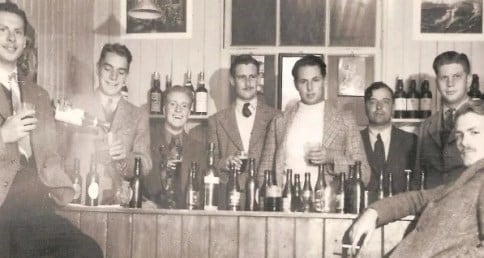
The guards at the Curragh had blanks in their weapons and the internees, both allied and German, were allowed to visit local pubs, go to evening dances and join fishing and golfing trips, and even fox hunts. The German internees were also allowed to attend parties and receptions at the German embassy in Dublin.
According to the records of the Curragh Golf Club, the honorary secretary of the club was to consult with the commanding officer of the camp “on the question of the officers of the belligerent nations being permitted to play golf, either as subscribers to the club or honorary members. It was later decided to permit German and British internees to play golf for 5 shillings per month.”
Club officials also later decided to let enlisted personnel play.
Paul Stormer, a German pilot whose Junkers JU-88 twin-engine aircraft was shot down by Spitfires over Ireland’s County Waterford in August 1942, described life for the German internees in the book “Luftwaffe Eagles Over Ireland,” by Justin Horgan and Paddy Cummins.
“Parties together with Irish friends and receptions at the German Embassy in Dublin were a welcome change to the life in the camp,” Stormer said. “One could play tennis or golf and some were members of local clubs. Highlight of the social life in Curragh were the horse races.”
Wolfe, meanwhile, was having none of it. On Dec. 13, 1941, only two weeks after his Spitfire crashed, he made an escape — actually, he just walked away after pulling off a ruse with the camp’s parole system.
By some accounts, he stopped first at a hotel for a meal and skipped out on the bill before boarding a train in Dublin bound for Belfast. He then made his way back to his RAF base in Eglinton.
To his great surprise, he was not welcomed back. Instead, the British quickly sent him back to the Curragh in what was seen as an attempt to maintain good relations with neutral Ireland.
There are varying accounts on how many allied and German internees were held at the Curragh, but most estimates put the number of Germans at about 250. They were held until the end of the war, while around 45 allied internees, including Wolfe, were released in October 1943 as it became more clear that the allies were gaining momentum in the war.
In a debriefing after he was released, Wolfe told of two other unsuccessful escape attempts he made, according to the WWII Irish Aviation website.
He was part of an escape attempt in February 1942, “which was unsuccessful,” and during which he was “somewhat severely beaten up by two Irish corporals” who captured him. In August 1942, “I managed to get outside the wire, but was caught almost immediately,” Wolfe said.
Wolfe eventually got his citizenship back and went on to fly combat missions in P-47 Thunderbolts for the 78th Fighter Group of the U.S. Army Air Forces. He also served in Korea and Vietnam, logging a total of 12,000 hours and nearly 900 combat missions across three wars before retiring as a lieutenant colonel. He died in Florida in 1994.
On Nov. 30, 2011, 70 years to the day after Bud Wolfe bailed out of his Spitfire, his two daughters — Betty Wolfe and Barbara Wolfe Kucharczyk, along with 12 other members of the extended Wolfe family — came to the spot on the Inishowen Peninsula in County Donegal where excavations were underway to recover Wolfe’s Spitfire from the bog.
“To be standing on the very spot where my dad’s plane came down 70 years ago almost to the very hour was certainly poignant,” Betty Wolfe told the Belfast Telegraph. “Looking around us at the rugged countryside and viewing the surrounding hills, especially on such a windy day, gave me a real understanding of the strength my dad would have needed to survive.”
The excavation work crews were able to recover Wolfe’s helmet from the wreckage and gave it to Betty Wolfe to hold briefly.
“It was especially moving for me to be able to hold his helmet,” she said. “In his last days, dad was very sick and all we were able to do was touch him and touching the helmet reminded me of those final moments with him so that was quiet poignant for me as well.”
Read the full article here
