



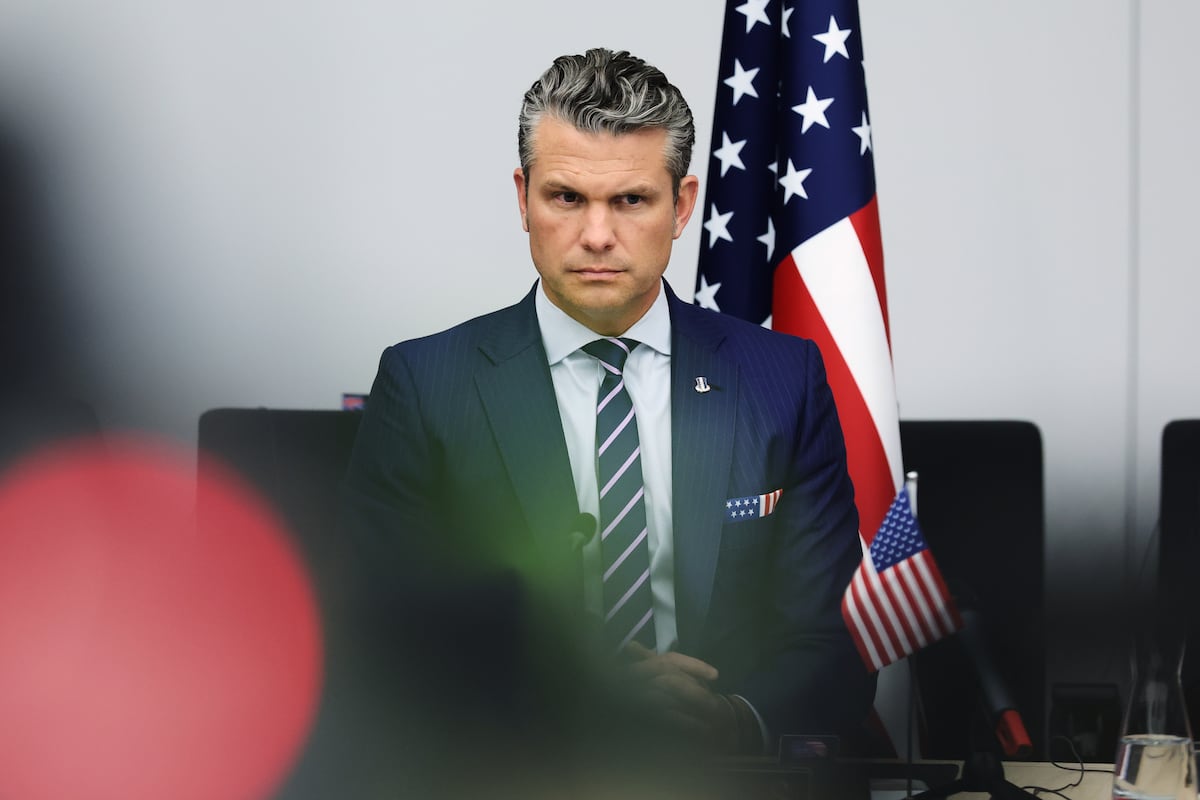

A Pentagon inspector general report confirmed Defense Secretary Pete Hegseth sent sensitive operational information about an impending strike in Yemen over his personal cell phone, potentially endangering the mission objectives and troops carrying it out.
The report, which was dated Dec. 2 and publicly released Thursday, found that Hegseth has the authority to decide whether information should be classified, and he determined the details he shared in a March 15 Signal chat “were either not classified or that he could safely declassify and use to create an ‘unclassified summary’ to provide to the Signal chat participants.”
One of those chat participants was, apparently unknowingly to Hegseth and other government officials, Atlantic editor Jeffrey Goldberg, who later that month published a bombshell report on the security breach.
Even if rules against disclosing classified information were not breached, the IG said Hegseth’s sharing of nonpublic information so close to an airstrike operation carried significant risks.
In the chat, the IG said, Hegseth disclosed the “quantity and strike times of manned U.S. aircraft over hostile territory over an unapproved, unsecure network approximately 2 to 4 hours before the execution of those strikes.”
“Using a personal cell phone to conduct official business and send nonpublic DoD information through Signal risks potential compromise of sensitive DoD information, which could cause harm to DoD personnel and mission objectives,” the report said.
The release of the long-awaited report reignited the controversy that followed Goldberg’s initial reports on the chats, which came to be known as Signalgate.
Some lawmakers called for Hegseth’s resignation in blistering statements.
“This was a rookie mistake that could have had dire consequences for our service members who put their lives on the line for our nation every day,” said House Armed Services Committee member Rep. Sarah Elfreth, D-Md.
“I am calling for [Hegseth’s] immediate resignation. In the coming days, I will use every tool at my disposal to hold him publicly accountable and restore the public’s faith in those who lead us and are responsible for our national security,” she said.
The Pentagon pushed back on the report, highlighting the IG’s observation that Hegseth had the authority as secretary to declassify information.
The report “totally exonerates Pete Hegseth,” Timothy Parlatore, Hegseth’s attorney and adviser, said in a video interview with conservative media outlet Real America’s Voice, which the Pentagon shared on its social media accounts.
“There’s no classified material in those texts,” Parlatore said. “Everything he declassified, he has within his authority to declassify.”
The IG said that then-U.S. Central Command commander Army Gen. Erik Kurilla sent four emails on March 14 and 15 that were classified “secret” and “not releasable to foreign nationals” to Hegseth and the acting chairman of the Joint Chiefs of Staff outlining plans for the strike, including operational details and updates. There were no markings within the emails indicating some elements were classified and others were not, the IG said, so investigators concluded all information in CENTCOM’s emails was classified.
On the day of the strike, Saturday, March 15, Hegseth and two assistants were at his home at Fort McNair in a temporary sensitive compartmented information facility, or SCIF. Hegseth sent information about the upcoming strike to a group chat, labeled “Houthi PC Small Group” that also included Vice President JD Vance, now-former national security adviser Mike Waltz, and Goldberg, who Waltz had added to the group, apparently by mistake.
Hegseth sent messages outlining, to the minute, when two waves of F-18 Hornet fighters were planned to launch, and approximately when each group of jets would hit their targets. Hegseth’s message also detailed plans for drone and Tomahawk missile strikes, the report said.
The strike plan information “substantially restated details” from CENTCOM commander Kurilla’s first email from March 14, which was marked SECRET/NOFORN, the IG said.
Former defense officials who spoke with Defense News at the time said such specific information about strike packages would typically be considered classified. Had information on the specific timing of aircraft launches, and their arrival at the targets, fallen into the hands of the Houthi terrorists the U.S. was targeting, the Houthis could have more easily targeted U.S. aircraft, experts said.
Hegseth declined the IG’s request for an interview, but provided a written statement in July, in which he said he determined that information did not need to be classified.
“I took non-specific general details which I determined, in my sole discretion, were either not classified, or that I could safely declassify [and created an] unclassified summary” of CENTCOM’s strike details, Hegseth said in his written response.
The IG concluded Hegseth does have the authority to decide what information should be classified.
But the IG said that his use of Signal, an unapproved commercially available messaging program on his personal cell phone, to send sensitive nonpublic operational information a few hours before the strikes occurred did not comply with the department’s rules on using personal devices for official business.
The Defense Department allows the use of personal devices for official government business, and the use of nonapproved, commercially available messaging applications, only in certain circumstances such as an emergency and if other official communications methods are unavailable, impractical or unreliable.
The report said that a DOD lawyer provided more context for the IG to consider, but did not provide supporting documentation to verify its claims. For that reason, the IG said, it did not include the provided context in the report’s release.
Stephen Losey is the air warfare reporter for Defense News. He previously covered leadership and personnel issues at Air Force Times, and the Pentagon, special operations and air warfare at Military.com. He has traveled to the Middle East to cover U.S. Air Force operations.
Read the full article here
