



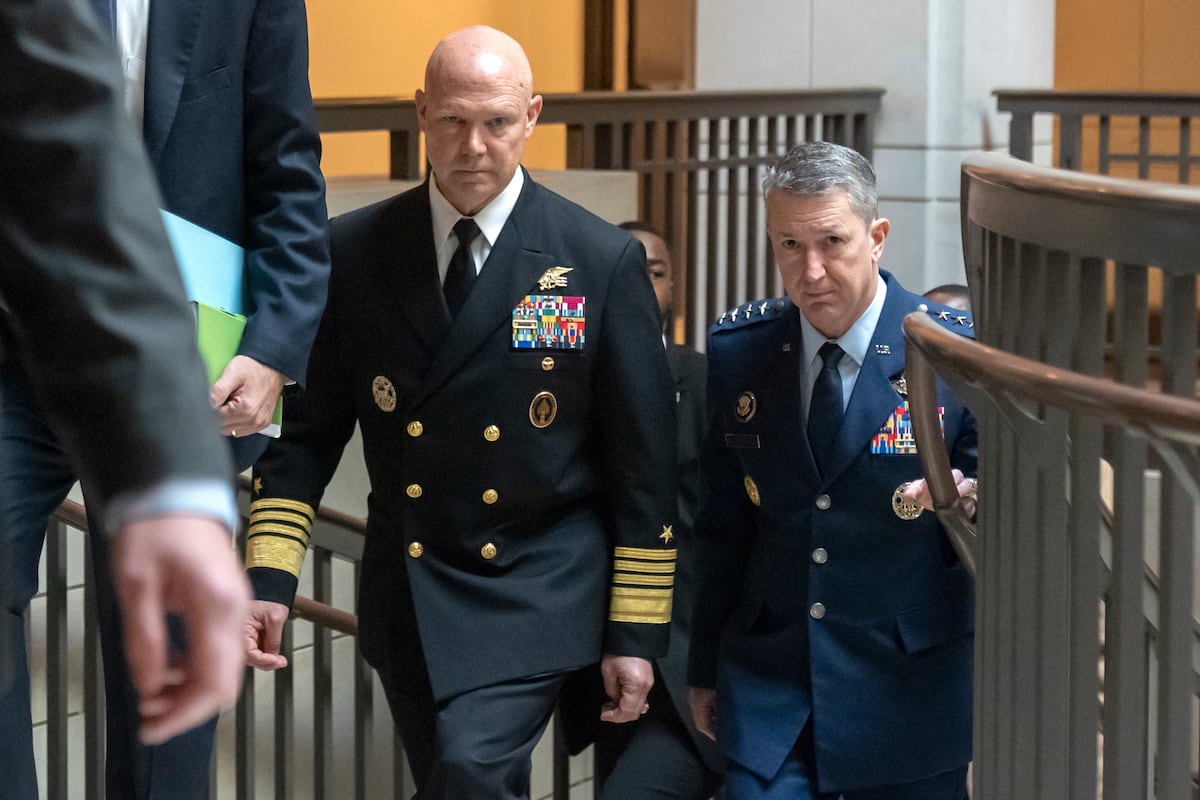

A Navy admiral told lawmakers Thursday that there was no “kill them all” order from Defense Secretary Pete Hegseth but grave questions and concerns remain as Congress scrutinizes an attack that killed two survivors of an initial strike on an alleged drug boat in international waters near Venezuela.
Adm. Frank “Mitch” Bradley “was very clear that he was given no such order, to give no quarter or to kill them all,” said Sen. Tom Cotton, who heads the Senate Intelligence Committee, as he exited a classified briefing.
While Cotton, R-Ark., defended the attack, Democrats who were also briefed and saw video of the survivors being killed questioned the Trump administration’s rationale and said the incident was deeply concerning.
“The order was basically: Destroy the drugs, kill the 11 people on the boat,” said Washington Rep. Adam Smith, the top Democrat on the House Armed Services Committee. Smith, who is demanding further investigation, said the survivors were “basically two shirtless people clinging to the bow of a capsized and inoperable boat, drifting in the water.”
Bradley was joined at the Capitol by Gen. Dan Caine, chairman of the Joint Chiefs of Staff, for briefings at a potentially crucial moment in the unfolding congressional investigation into how Hegseth handled the operation. There are questions about whether the strike may have violated the law.
Congressional investigation gets underway
Lawmakers want a full accounting after The Washington Post reported that Bradley on Sept. 2 ordered an attack on the survivors to comply with a directive from Hegseth to “kill everybody.” Legal experts say the attack amounts to a crime if the survivors were targeted.
Cotton said that from watching the video, he “saw two survivors trying to flip a boat loaded with drugs bound for United States back over so they could stay in the fight.”
Connecticut Rep. Jim Himes, the top Democrat on the House Intelligence Committee, described the survivors’ state differently. “You have two individuals in clear distress without any means of locomotion, with a destroyed vessel, were killed by the United States,” he said.
Underpinning President Donald Trump’s campaign against suspected traffickers is his argument that drug cartels amount to armed combatants because their cargo poses a threat to American lives.
Smith acknowledged there was likely cocaine on the boat, but he objects to the Republican administration’s rationale for continued attacks on alleged drug runners who may or may not be heading to the United States. “That’s really the core of the problem with all of this,” he said. “That incredibly broad definition, I think, is what sets in motion all of these problems about using lethal force and using the military.”
Cotton said it was “gratifying” that the U.S. military was taking “the battle” to cartels. Other lawmakers, including a handful of Republicans, worry that the campaign is pushing against the bounds of laws that govern armed conflict.
Among those also briefed were the leaders of the House and Senate Armed Services committees and the Intelligence Committee in each chamber. Several of the lawmakers in the briefings declined to comment as they exited.
Democrats are demanding the release of the full video of the Sept. 2 attack, as well as written records of the orders and any directives from Hegseth. Republicans, who control the national security committees, have not publicly called for those documents, but have pledged a thorough review.
Who is Adm. Bradley?
At the time of the attack, Bradley was the commander of Joint Special Operations Command, overseeing coordinated operations between the military’s elite special operations units out of Fort Bragg in North Carolina. About a month after the strike, he was promoted to commander of U.S. Special Operations Command.
His military career, spanning more than three decades, was mostly spent serving in the elite Navy SEALs and commanding joint operations. He was among the first special forces officers to deploy to Afghanistan after the Sept. 11 attacks. His latest promotion to admiral was approved by unanimous voice vote in the Senate this year, and Democratic and Republican senators praised his record.
Sen. Thom Tillis, R-N.C., has described Bradley as among those who are “rock solid” and “the most extraordinary people that have ever served in the military.”
But lawmakers like Tillis have also made it clear they expect a reckoning if it is found that survivors were targeted. “Anybody in the chain of command that was responsible for it, that had vision of it, needs to be held accountable,” he said.
What else are lawmakers seeking?
The scope of the investigation is unclear, but there is other documentation of the strike that could fill in what happened. Obtaining that information, though, will largely depend on action from Republican lawmakers — a potentially painful prospect for them if it puts them at odds with the president.
Rhode Island Sen. Jack Reed, the top Democrat on the Armed Services Committee, said he and the Senate Armed Services Committee chair, GOP Sen. Roger Wicker have formally requested the executive orders authorizing the operations and the complete videos from the strikes. They are also seeking the intelligence that identified the vessels as legitimate targets, the rules of engagement for the attacks and any criteria used to determine who was a combatant and who was a civilian.
Republican lawmakers who are close to Trump have sought to defend Hegseth.
More than 80 people have been killed in the series of strikes that started in September.
Sen. Richard Blumenthal, D-Conn., said it was clear that Hegseth is responsible, even if the defense secretary did not explicitly order a second attack.
“He may not have been in the room, but he was in the loop,” Blumenthal said. “And it was his order that was instrumental and foreseeably resulted in the deaths of these survivors.”
Associated Press writer Mary Clare Jalonick contributed to this report.
Read the full article here
